
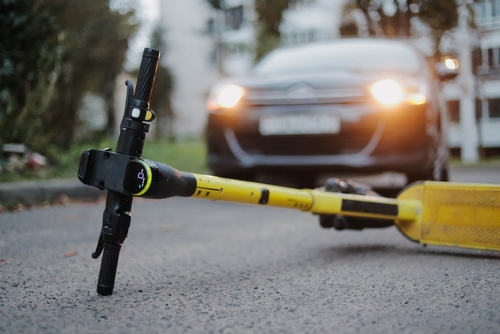
When the weather warms up, shared scooters reappear on sidewalks and street corners by the thousands, ready to unlock from a phone in seconds. With more riders come more crashes. A rider gets clipped by a car turning across a bike lane, a pedestrian is struck on a crowded sidewalk, or a scooter's brakes fail at speed. The injuries are often far more serious than people expect from a device that can reach speeds around 20 miles per hour.
When someone is hurt, the legal questions rarely point to a single party. Depending on how the crash happened, responsibility may fall on a negligent driver, the rider, the scooter company, or the manufacturer. The answer depends on the facts, and on rules that treat these cases very differently from an ordinary car wreck.
At Hilliard Law, we handle serious injury and wrongful death cases involving vehicle crashes, including collisions involving e-scooter riders and pedestrians. These claims often involve disputed fault, well-funded companies, and short legal deadlines that can quietly affect what an injured person is able to recover.
How Texas Law Treats E-Scooters
Texas Transportation Code Chapter 551 classifies e-scooters as "motor-assisted scooters," a category separate from cars, motorcycles, and bicycles. A standard personal scooter does not require a driver's license, registration, or insurance. Riders may generally operate motor-assisted scooters on roads with posted speed limits of 35 miles per hour or less, as well as bicycle paths and sidewalks, subject to local restrictions. Cities can impose additional rules, including limits on where and how scooters may be used.
Recent changes added more structure. Drivers are now required to yield to scooter riders in crosswalks and at intersections, and riding faster than about 8 miles per hour on a sidewalk can be treated as evidence of unreasonable speed. Cities are also allowed to layer on their own rules, including curfews, minimum ages, and sidewalk bans.
Corpus Christi, for example, regulates rental scooters through a dockless-vehicle license agreement that geofences speeds to 10 miles per hour along the Seawall and 20 miles per hour elsewhere in the city, and requires scooters to be parked upright without blocking sidewalks, bike lanes, ramps, or transit stops.
Who Can Be Held Responsible After a Crash
Liability turns on how the collision happened and who was injured. Depending on the facts, responsible parties may include:
- A negligent driver who failed to yield, turned across a rider's path, changed lanes carelessly, or was distracted
- The scooter rider, if careless riding caused a crash or struck a pedestrian
- The rental or scooter-share company, for a defective or poorly maintained scooter, or for hazards tied to where scooters are left
- The manufacturer, if a design or mechanical defect in the brakes, throttle, stem, or battery caused the crash
Texas uses a modified comparative fault system, so responsibility can be divided among more than one party. Identifying every potential source of recovery becomes especially important when one party is uninsured or carries limits too low to cover the full damages.
Why Claims Against Scooter Companies Are Harder Than Riders Expect
Scooter-share companies such as Lime and Bird build their rental agreements to limit lawsuits. Before a scooter unlocks, the app requires the rider to accept terms that usually include:
- A liability waiver releasing the company except in cases of gross negligence
- A mandatory arbitration clause that pushes disputes out of court and into private arbitration
- A class-action waiver
These provisions are not automatically enforceable, and courts have declined to uphold waivers and arbitration clauses that are overbroad or unconscionable. The strongest claims against a company tend to rest on something the contract cannot cleanly waive: a genuine product or maintenance failure, such as brakes that don't respond, a throttle that sticks, or a cracked frame, or conduct that rises to gross negligence.
There is also an important distinction for pedestrians. A person struck by a scooter rider never signed the rental agreement, so the arbitration and waiver language generally does not bind them. Riders should also know that companies revise these agreements frequently and that some impose short windows to opt out of arbitration, which is one reason acting quickly helps protect a claim.
How Insurers Try to Shift Blame to the Rider
Like bicycle and motorcycle claims, scooter cases often become a fight over fault. Drivers and their insurers frequently argue that the rider:
- Darted out or "came out of nowhere"
- Was riding somewhere they should not have been
- Was not wearing a helmet
- Had been drinking before the crash
Under Texas's modified comparative fault rule, a rider found partly responsible has their recovery reduced by their percentage of fault, and a rider found more than 50 percent at fault recovers nothing. If a jury awarded $200,000 but found the rider 20 percent responsible, the recovery would fall to $160,000; at 51 percent, it would disappear entirely. Helmet use and alcohol can become arguments about the rider's own conduct, but both are fact-specific and do not automatically defeat a claim. Accepting an insurer's early account of what happened can cost a rider a significant part of their recovery.
The Injuries Are Often Serious
Because riders are completely exposed, scooter crashes frequently cause serious harm. Common injuries include:
- Traumatic brain injuries and concussions
- Fractures, particularly to the wrists, arms, and ankles
- Facial and dental injuries
- Road rash and soft-tissue damage
- Spinal injuries
- Catastrophic injuries and, in the worst cases, wrongful death
These injuries often lead to extensive medical costs, lost income, and long recoveries. Identifying every party responsible can determine whether an injured victim receives full compensation.
Evidence That Can Decide a Scooter Claim
Scooter crashes happen quickly and often without neutral witnesses, and important evidence disappears fast. Footage gets overwritten, scooters are picked up and redeployed, and memories fade. Evidence worth preserving early includes:
- The crash or police report
- Photos of the scene, the scooter, the vehicle, and the injuries
- App and GPS data showing speed, route, and ride times
- The company's maintenance and inspection records for the specific scooter
- Surveillance, dashcam, or doorbell-camera footage
- Witness statements taken close to the time of the crash
- Medical records documenting the nature and extent of the injuries
App and maintenance records are unique to these cases and can be difficult to obtain without prompt legal action, which is one reason early investigation often makes the difference.
Hurt in an E-Scooter Crash? Hilliard Law Can Help.
E-scooter injury claims can involve a negligent driver, a well-funded rental company, and a government entity, sometimes all at once, each with its own rules and defenses. Sorting out who is responsible, and acting before deadlines pass and evidence disappears, can have a real effect on the outcome.
You may have grounds to pursue a claim if:
- A driver hit you while you were riding an e-scooter
- A car turned across your path or opened a door into your lane
- A rental scooter malfunctioned, or a defective brake, tire, or battery caused the crash
- A pothole or other unsafe road condition caused you to lose control
- You were struck by a scooter rider while walking
- A loved one suffered fatal injuries in an e-scooter crash
You may still have a claim even if another party argues you share part of the blame. At Hilliard Law, we fight for victims involved in all types of vehicle crashes and e-scooter crashes, and are available to help you.
If you or someone you love was seriously hurt in an e-scooter crash and have questions about your legal options, call (866) 927-3420 or contact us online for a FREE consultation.